
PMI Certification is so much more than a piece of paper it’s a career-defining milestone that says you’ve made it to the top tier of project management. But let me tell you, getting there isn’t easy. If all you do is study from a guide, you’re likely to fall short. I’ve seen so many people get their PMP by using a simple trick: throwing themselves at PMP Practice Exam simulators over and over again. In this guide, we’re going to walk you through the ‘why’ behind this certification and give you a straightforward plan to use practice tests to bank a passing score.
Think of this as your battle plan for the most important project you’ll be running this year getting your PMP. We’re going to kick off by getting clear on the ‘why’, and then move on to the ‘how’, making sure you walk into that exam with a solid head on your shoulders and loads of confidence.
PMP Certification: Why It Still Dominates the Project Management Market
Spending thousands and thousands of dollars on getting a PMI Certification is a serious investment of time and energy. So what’s the pay-off? The numbers don’t lie getting a PMP opens up a whole new world of opportunities, and it’s not just about throwing more money at you.
PMP Certification Demand Across Global Industries
We’re in a world where every business and every government is running on projects. The data is clear: we need more people who can get things done on time and on budget. It’s a talent shortage that’s not just theoretical 29.8 million new project professionals are needed by 2035 alone. This is no vague prediction; it’s a crisis that’s being felt right now in industries from construction to IT, and from healthcare to manufacturing.
For you personally, that means having a step on the career ladder that just isn’t available to non-PMPs. You’re not just qualified for a job with a PMP Practice Exam you’re a solution to a global problem that employers are desperate to solve.
Salary Growth, Career Mobility, and Leadership Recognition
It’s plain to see that getting a PMP has a serious impact on your wallet. On average, PMPs earn 33% more than their non-certified counterparts. And it’s not just a matter of a few percentage points in the US for example, the median salary for a PMP is a whopping $130,000. Compare that to $90,000 for those without the certification and you’re looking at an $40,000 a year difference.
But it’s not all about the money. The PMI Certification also gets you the intangible benefits that make you a leader building trust with your stakeholders, managing risk with ease, and getting the best out of your team. And it’s a badge that says to employers and your peers that you’re an expert in your field and that you’re committed to upholding the highest standards of professionalism.
Why Employers Prefer PMP-Certified Professionals
If you’re an employer, the benefits of having a PMP on staff are clear. Projects led by certified professionals are more likely to hit the mark, finish on budget and stick to their deadlines. And for the employer, that means a whole lot less risk and a whole lot more chance of getting a return on their investments. So for them, hiring a PMP is not just a gut instinct, it’s a good business decision.
Understanding the Latest PMP Exam Format and PMI Mindset
You don’t even start a project without knowing what you’re getting yourself into. Same thing applies to the exam. Taking the time to figure out what your facing is the first step and a big one at that.
PMP Exam Domains: People, Process, and Business Environment
The PMP exam is now based on three big performance areas that reflect the modern project managers role:
- People (42%): All about the soft skills, leading a team, handling conflict, keeping stakeholders happy, and negotiating your way through tricky situations.
- Process (50%): Covers all the technical bits, managing scope, schedules, budgets, quality, and risks, the core of the job.
- Business Environment (8%): Deals with the bigger picture, linking project delivery to the wider org strategy and keeping an eye on compliance.
Types of PMP Practice Exams You Should Be Using
Not all practice resources are created equal. To really get somewhere with your prep you need to use a bit of strategy and put different types of tests to use at various stages of your prep.
Full-Length PMP Mock Exams vs. Topic-Wise Practice Tests
- Full Length Mock Exams (180 questions), these are like your dress rehearsals. Use them to fine tune everything, build up your endurance and get a true baseline of how you perform. You want to get a few in in your last few weeks before the exam to put yourself to the test.
- Topic-wise or Domain Quizzes: These are your ‘targeted’ training tools. After you find yourself struggling with a particular area (e.g. Risk Management), take a 20 question quiz on that topic to help solidify the material in your mind and make sure you really get it before moving on.
PMI Official Practice Questions vs. High-Quality Third-Party Simulators
- PMI’s Official Resources: PMI Certification themselves have a official practice exam and questions. These are basically gold standard for getting a feel for the exact type of questions you’ll get and the difficulty level.
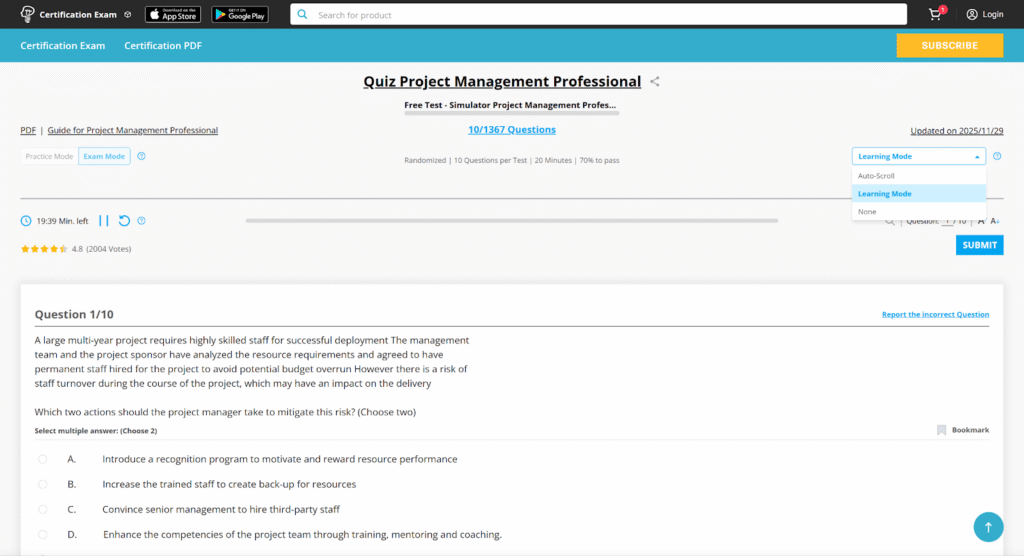
- Third Party Simulators: Places like PM PrepCast, TIA Exams and others have massive question banks (sometimes over 1,000 questions), detailed explanations for each question, and analytics to boot. Theyre super useful for getting a volume and variety of practice that you’re going to need. Some people find value in structured, exam aligned resources like the Certification-Exam platform which is just focused on getting you domain specific practice if that’s what you need.
AI-Powered and Adaptive Practice Exams for Faster Improvement
Some newer platforms use that fancy AI tech to adapt question difficulty on the fly based on how you’re doing, or to pinpoint those areas where you’re most vulnerable so you can focus on the stuff that really matters. This means you can actually make the most of your study time by constantly pushing yourself to a level that makes sense for you.
Building a High-Performance PMP Study Plan Using Practice Exams
Don’t even get me started on the idea of just winging it and hoping for the best that just leads to a whole lot of stress and wasted time. So, what you want to do is to integrate practice exams into a sensible schedule.
When to Start Practice Exams During PMP Preparation
Don’t start practice exams too early, but don’t wait too long either. What you want to do is to take a full-length PMI Certification the moment you’ve finished going through all the material. Don’t worry about your score just use it to get a sense of where your strengths and weaknesses are. That’s what that score is for to tell you where to focus.
Smart Scheduling: Mixing Study, Revision, and Mock Tests
Here’s a rough guide for the last 6-8 weeks before you sit the exam:
- Weekdays (1-2 hours): Have a good in-depth study session on one area where you need improvement, followed by a quick 20-question quiz to check how much you actually remember.
- Weekends (3-4 hours): Take one full-length PMP exam under timed conditions, then spend some quality time going over every single question.
Using Practice Exam Analytics to Target High-Weight Domains
A good simulator will give you a dashboard that shows your performance in each domain (People, Process, Business) so you can see at a glance what you’re doing well and where you’re struggling. If you’re consistently getting Process right but really struggling with People, you know exactly where to concentrate your effort. That’s a whole lot better than just winging it and hoping.
PMP Exam Strategies That Top Scorers Use
It’s not just about taking practice test; it’s about how you take them. These strategies really do help build skill.
Simulating Real Exam Conditions to Build Stamina
For your final 3-5 mock exams, go all out:
- Time: Set that timer for 230 minutes with no breaks allowed.
- Environment: Find a quiet room, put your phone on silent, and no notes allowed.
- Breaks: Take them at 60 and 120 questions, and make them quick, 10 minutes flat.
- Interface: Get used to using the online calculator and whiteboard so you’re ready for exam day.
Time-Management Techniques for 180 Questions
You’ve got about 76 seconds per question, not a lot, but top scorers keep a steady pace:
- First Pass: Blast through the ones you know straight away, get the easy ones out of the way and flag the ones that are giving you trouble. Don’t spend more than 90 seconds on any one question to keep your momentum going.
- Review Pass: Go back to those tricky ones and see if you can nail them with the time you’ve got left.
- The Golden Rule: Don’t leave any questions blank. There’s no penalty for taking a punt, it’s better to have a stab at an answer than to leave it blank.
Elimination Techniques and Smart Guessing Strategies
When all else fails, start by eliminating the obviously rubbish answers. Look out for words like “always” or “never” – they’re often a giveaway. Then try to figure out which choice is the most proactive, formal and follows a proper process that one’s probably your best bet for being PMI Certification-aligned.
How to Analyze PMI Certification Results the Right Way
The real learning happens once you’ve finished the test – and reviewing your results in detail is a big part of that. Spending 3-4 hours poring over your 4-hour practice exam is not uncommon and it’s a key part of getting better.
Identifying Knowledge Gaps vs. Conceptual Misunderstandings
- Knowledge Gap: You got a question wrong because you’d forgotten a formula. Fix: Get that formula stuck in your head.
- Conceptual Misunderstanding: You got a question wrong because you chose the wrong solution, it was down to a misunderstanding of a principle or technique. Fix: Go back and revisit the basics, make sure you understand the underlying principle.
Adjusting Your Study Plan Based on Performance Trends
If your results show you’re not getting any better in the “Manage Risk” tasks after two weeks, it’s time to change your approach. Maybe you need to switch up your learning methods – try a different video tutorial, join a study group or try creating some mind maps to help you understand things better. Let the data from your PMI Certification guide your study plan.
Agile and Hybrid Focus: The Game-Changer in PMP Practice Exams
Your comfort level with Agile is a key factor in how well you’ll do on the exam.
Why Agile and Hybrid Questions Dominate the PMP Exam
The PMI Certification recognises that project management has moved on it’s no longer just about following a formula. The exam now wants to see that you can handle projects in all sorts of different environments. Expect a lot of questions on servant leadership, iterative planning, backlog prioritisation and adapting to change.
Scenario-Based Practice Questions You Must Master
Look for practice questions that give you a real-world scenario to deal with. You know – the kind of thing that might come up in a real project. Questions like:
- “A stakeholder wants a new feature in the current iteration. What do you do?”
- “The team’s velocity has dropped for two consecutive sprints. What’s the first thing you should do?”
Practice recognising whether the scenario is a Scrum, Kanban or hybrid situation – because the right answer will depend on which one it is.
Aligning Practice Exams with Real-World Project Situations
The best practice questions are the ones that feel like a short case study. They want to see if you can be a servant leader, facilitate rather than tell people what to do, and focus on delivering actual value. Make sure your chosen PMP practice exam bank has a strong, up-to-date Agile component.
Online PMP Exam Simulators and Mobile Apps
Most top simulators are cloud-based so you can study from whatever device you fancy. Some even have mobile apps so you can do a quick quiz on the go when you get a moment. But the thing is: it’s not just about being able to access your study materials from anywhere it’s about having access to a really big, high-quality bank of questions.
Tracking Progress, Accuracy, and Confidence Over Time
The metric you need to be looking at is how far you’re progressing, and in what areas you’re improving what your results are telling you to focus on next. And to be honest, watching your scores creep up in your weaker areas is an absolute confidence builder.
Final PMP Exam Readiness: Turning Practice Exams Into a Passing Score
In the last week, you want to be refining your work, not just cramming in as much as you can at the last minute.
Mental Preparation, Stress Control, and Focus Techniques
Your prep is done now it’s time to trust the work you’ve put in. In the final days make sure you’re getting good sleep, eating well and having a bit of exercise. Use breathing techniques to calm your nerves and imagine yourself breezing through the exam with confidence.
Exam-Day Strategy: Time, Confidence, and PMI Mindset
On the day, just keep things simple:
- Use the Tutorial: Take that few minutes at the start to calm your nerves and get your head in the right place.
- Stick to Your Plan: Don’t let nerves get the better of you keep to that time-management strategy you’ve been working so hard to master.
- Tap Into Your Strengths: For every tough question that comes up pause and think “What would the ideal PMI project manager do in this situation?”
- Go For It With Confidence: You’ve done all the hard work, now just go out there and claim that PMP certification.
Conclusion: From PMP Practice Exam to Long-Term Career Success
Getting that PMP certification is like running your own little project you need to define your scope (the exam content), schedule (your study plan) and the quality outcome you want (passing the exam). And to be honest, the one resource that will make all the difference is using PMP Practice Exam simulations strategically.